

Spotlight

Chicago Event Management Earns GOLD Organization Certification 2026-2028

Thursday, August 27

Chicago Event Management Earns Gold Organization Certification from the Council for Responsible Sport

Producer of the Bank of America Chicago Distance Series recognized for more than a decade of leadership in environmental stewardship, community investment, and inclusive event design

CHICAGO, IL - Chicago Event Management (CEM), the endurance industry leader behind the Bank of America Chicago Distance Series, has been awarded Gold Organization Certification by the Council for Responsible Sport (CRS), the world’s leading environmental, social and economic sustainability certification program for sports events and organizations. The recognition reflects CEM’s ongoing commitment to operating with purpose and embedding social and environmental responsibility across every aspect of its work.

Gold Organization Certification is awarded to organizations that achieve 75 percent or more of the total best practices outlined in the Council for Responsible Sport’s standards for responsible sport, spanning six areas of impact: planning and communications, procurement, resource management, access and equity, community legacy, and innovation and excellence.

CEM’s relationship with the Council for Responsible Sport dates back to 2010, when the Bank of America Chicago Marathon first received CRS certification, making it one of the earliest major endurance events in the country to pursue independent verification of its social and environmental practices. In the years since, CEM has steadily advanced its work, earning recognition across multiple events in the Chicago Distance Series portfolio, including the Bank of America Chicago 13.1 and the Bank of America Shamrock Shuffle.

“This recognition is a reflection of the extraordinary people across our organization and events who have a shared belief that our races can be a force for good in the communities we run through; said Carey Pinkowski, CEO of Chicago Event Management. “It is the result of more than a decade of hard work and dedication. Our team shows up every day committed to leading with purpose and accountability, and our participants, volunteers, vendors, local businesses and community stakeholders have been alongside us every step of the way. This honor belongs to everyone who has been part of this journey.”

The Council for Responsible Sport recognized CEM for the following accomplishments:

  • Planning and Communications: CEM is building a foundation for social and environmental responsibility, establishing policies, goals, and accountability that will continue to guide the organization and its event operations into the future. A cornerstone of this work was creating CEM’s first Diversity, Equity, and Inclusion (DEI) Statement and Action Plan, ensuring equity and inclusion are woven into our culture, decision-making, and event experience.

  • Procurement: Sustainable procurement practices are being advanced by prioritizing responsible purchasing, reducing unnecessary consumption and integrating environmental and social considerations into sourcing decisions.

  • Resource Management: Operational emissions are being actively reduced through the introduction of battery storage systems, creative material reuse and close collaboration with event partners to minimize waste and environmental footprint.

  • Access & Equity: A stronger commitment to inclusive, accessible events has taken shape by removing barriers to participation and expanding opportunities for underrepresented communities.

  • Community Legacy: Lasting positive impacts are being generated for the communities where the events take place. Supporting local economies, collaborating with community partners, advancing charitable initiatives, and creating long-term social value beyond the events.

“Chicago Event Management exemplifies what it looks like when an organization commits to responsible practices not as a one-time effort, but as a fundamental part of how it operates,” said Michelle Sandquist, Certification Director for the Council for Responsible Sport. “The Gold Organization Certification reflects years of meaningful progress across social and environmental impact, and we are proud to recognize CEM’s leadership in the endurance industry.”

CEM joins a select group of organizations worldwide to achieve organizational-level certification from the Council for Responsible Sport, a distinction that recognizes sustained, institution-wide commitment rather than individual event performance. The full list of CRS-certified events and organizations is available at councilforresponsiblesport.org/certified-events.

ABOUT CHICAGO EVENT MANAGEMENT

Chicago Event Management (CEM) is a leader in the endurance industry, best known for its production of the Bank of America Chicago Marathon, a member of the Abbott World Marathon Majors. Since its founding in 1996, CEM has worked closely with community partners and leaders in event production to create world-renowned events in the heart of Chicago. Its portfolio includes citywide road races and wellness events that emphasize safety, sustainability, and community impact. To learn more about Chicago Event Management, visit cemevent.com.
The Council for Responsible Sport is proud to announce a new partnership with Headsweats.

The Council for Responsible Sport is proud to announce a new partnership with Headsweats.

Headsweats has long been a leader in performance headwear, trusted by endurance athletes nationwide. The company is also committed to responsible manufacturing, including the use of recycled materials and ongoing efforts to reduce environmental impact.

We’re excited that Headsweats products will be worn by our charity runners and walkers, as well as our on-site verifiers at certified events. This partnership reflects both performance and purpose visible on the course and behind the scenes.

Together, we continue aligning sport with sustainability.

GRANDMA’S MARATHON EARNS PLACE AMONG WORLD’S MOST SUSTAINABLE LARGE EVENTS Earns Highest Certification Level from Council for Responsible Sport

FOR IMMEDIATE RELEASE
Contact: Zach Schneider
Marketing & Public Relations Director
zach@grandmasmarathon.com
(218) 727-0947

GRANDMA’S MARATHON EARNS PLACE AMONG

WORLD’S MOST SUSTAINABLE LARGE EVENTS

Earns Highest Certification Level from Council for Responsible Sport

(DULUTH, MINN.) --- Grandma’s Marathon has earned the Evergreen Certification from the Council for Responsible Sport, recognizing the organization’s ongoing commitment to environmental stewardship, community impact, and responsible event management.

The Evergreen Certification is the most rigorous standard offered by the Council for Responsible Sport, requiring a demonstrated commitment to sustainability and social equity across all aspects of race planning and execution.

“We believe Grandma’s Marathon can and should inspire meaningful change, not only in our individual participants but in our community as a whole,” Marketing & Public Relations Director Zach Schneider said. “Our staff and partners have worked tirelessly to put these values of sustainability into practice within our event, and we’re excited to further ingrain these values into our organization as we look to the future.”

The race first received the Gold Certification – one level below Evergreen – two years ago, and this year received 61 of a possible 66 credits to move up to the highest certification level possible.

Grandma’s Marathon becomes only the third United States marathon to receive the Evergreen Certification, joining the Chicago and Los Angeles Marathons.

“Grandma’s Marathon once again delivered a sustainability program that felt thoughtful and genuinely rooted in place,” Council for Responsible Sport certifier Laura Sivels said. “They approached each waste stream with intention, worked closely with community partners, and tied the experience back to what makes the Lake Superior region unique.”

London and Toronto Marathons have also earned the Evergreen Certification, as have other major events such as the US Olympic Track & Field Trials, the MLB All-Star Game, and the NCAA Men’s & Women’s Final Fours.

Among the environmental efforts during the 2025 race weekend that contributed to the Evergreen Certification of Grandma’s Marathon were:

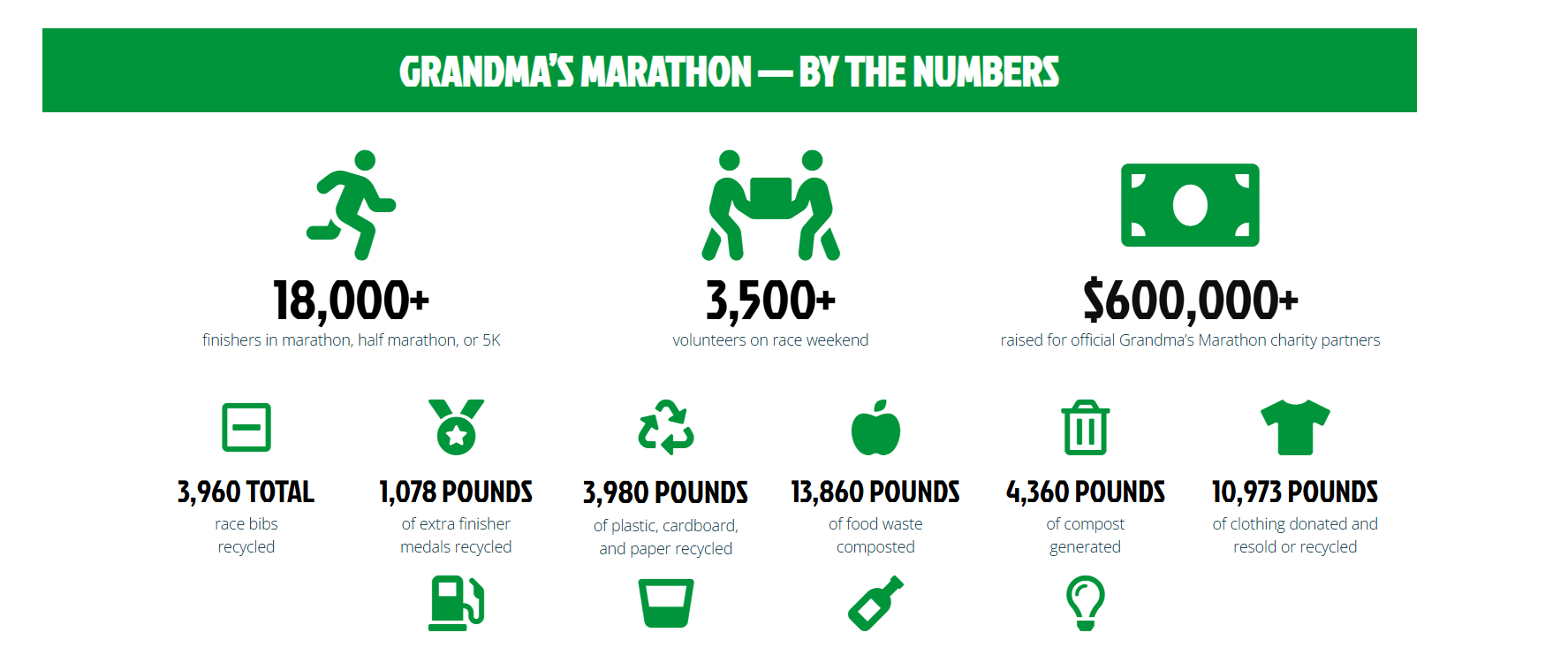
• 436,000 cups composted & 50,000 cups kept out of landfills through use of reusable cups and partnership with Hiccup

• 148,000 plastic bottles avoided by supplying racecourse water via trucks and hydrants

• 234,000 pounds of CO2 avoided by bussing participants to the start line and 382,000 pounds of CO2 voluntarily offset by participants

• 6,900 pounds of recycled plastics, cardboard, and paper

• 784 pounds of recycled plastic film and Heat Sheets

• 7,511 pounds of clothing donated and resold or recycled through a partnership with True North Goodwill

• 50 pounds of nutritional packets recycled

• 60,600 pounds of compost generated

• 237 bikes checked at free bike valet

Among the social and community efforts during the 2025 race weekend that contributed to the Evergreen Certification of Grandma’s Marathon were:

• $39.4 million estimated economic impact to Duluth and surrounding region

• $600,000 raised for official charity partners

• 737 pounds of food donated to local food shelves and community organizations

• 166 free entries through Running to Common Ground program

• 67 organizations using items in free equipment lending library

After being originally certified for the first time two years ago, organizers set an internal goal for the past two years to increase their sustainability efforts to earn the Evergreen Certification in 2025.

“It shows how quickly and meaningfully Grandma’s Marathon has integrated responsible sport principles into its planning, operations, and community engagement,” Sivels said. “The growth since their first certification reflects both dedication and a clear long-term vision to reduce impacts and enhance benefits for participants, partners, and the region.”

“On one hand, it’s mission accomplished. We’re immensely proud of this certification,” Schneider added, “but on the other hand it also needs to propel us forward. There’s more to be done in this space, and we’re looking forward to the challenge of maintaining what we’re doing while finding even more ways to help protect and serve our community.”

For any questions or interview requests, please contact Marketing & Public Relations Director Zach Schneider via phone at (218) 343-9874 or via email at zach@grandmasmarathon.com.

ABOUT THE COUNCIL FOR RESPONSIBLE SPORT The Council for Responsible Sport envisions a world in which responsibly produced sports events are the standard. Its mission is to provide objective, independent verification of event organizers’ social and environmental efforts to positively impact their communities.

Since 2007, the Council has developed and continually updated the Event Certification standards, which have been adopted by more than 250 events globally.

###

ABOUT GRANDMA’S MARATHON Grandma’s Marathon began in 1977 when a group of local runners planned a scenic road race from Two Harbors to Duluth, Minnesota. After seeing just 150 registered participants that year, the marathon has now grown into the 10th largest in the United States. The race got its name from the Duluth-based group of famous Grandma’s Restaurants, the first major sponsor of the marathon. Having now added the Garry Bjorklund Half Marathon and William A. Irvin 5K, the race weekend now welcomes more than 20,000 participants to Duluth and the surrounding region each year. As the popularity of Grandma’s Marathon weekend has grown, our mission has stayed the same – to organize, promote, and deliver annual events and programs that cultivate running, educational, social, and charitable opportunities to our communities. Grandma’s Marathon-Duluth, Inc. is a 501(c)(3) tax-exempt nonprofit organization with a 10-person, full-time staff and a 17-member Board of Directors.

Bank of America Chicago 13.1 Receives Evergreen Certification from the Council for Responsible Sport

CHICAGO – The Bank of America Chicago 13.1 and Council for Responsible Sport announced today the event earned Evergreen Certification, a recognition reserved for sporting events that demonstrate the highest possible commitment to environmental and social responsibility. The Chicago 13.1 debuted in 2022 with the vision to reimagine what running can be in Chicago, offering a weekend of health-and wellness-based activities for participants and community members on Chicago’s West Side.


“The Bank of America Chicago 13.1 is a stellar example of responsible sport,” said Aileen McManamon, lead certifier for the Council for Responsible Sport. “The Reimagine the Run model of bringing the half marathon to a vibrant but overlooked community in the city is definitely a ‘best practice’ case study.”


“Our team is humbled to receive Evergreen Certification from the Council for Responsible Sport,” said Carey Pinkowski, executive race director of the Bank of America Chicago 13.1. “The Bank of America Chicago 13.1 started out as an idea and was brought to life with the support of community members and businesses on Chicago’s West Side. We share and celebrate this accomplishment with everyone who played a role in making this event possible.”


The goal to reimagine running in Chicago has been a critical factor in the development and production of the Bank of America Chicago 13.1. To stay true to this vision, event organizers worked with community members, non-profit organizations and business on Chicago’s West Side to co-create an event experience that is meaningful, beneficial and representative of the West Side. The result is a world-class half marathon that starts and finishes in Garfield Park, the oldest park on the West Side, with a 13.1-mile course traveling through Humboldt and Douglass Parks while traversing the neighborhoods that line the boulevards connecting all three parks. Held in conjunction with the half marathon is a free Race Day Festival for participants and community members featuring a mix of entertainment, health and wellness activities and community activations.


Other examples of the event’s commitment to environmental and social responsibility include:


  • Support of local businesses: Runners and spectators are encouraged to support the local economy race weekend by visiting and shopping at local businesses. In addition to this, the event prioritized working with West Side businesses, organizations and artists that supported the production of the event and served as vendors and performers during the race weekend festivals.

  • Composting organic waste: Diverting waste from the landfill is a priority of the event, with compostable materials like food scraps and hydration cups collected by volunteers and picked up by The Urban Canopy, a local compost service. The finished compost was donated to Kuumba Tre-Ahm Community Garden in Garfield Park, where it nourishes the garden beds as a nutrient rich soil amendment. The community garden, named after the sixth principle of Kwanzaa and the owner’s two grandsons, is part of the Garfield Park Garden Network, a resident-led effort to enhance local green spaces and engage more community members in the local food system.

  • Charity Program: Participants raised more than $150,000 on behalf of nine charity partners that are creating a positive impact on Chicago’s West Side and throughout the city. Each non-profit partner has a focus on empowering youth, advancing health equity and supporting community development.

  • Offset race weekend travel: In 2023, the Bank of America 13.1 partnered with Native to provide participants with a way to offset emissions from travel to the event. Native met exhaustive environmental standards to be recognized as a certified B Corporation. All proceeds supported Native’s “From Waste to Fuel: Improving Agriculture and Livelihoods in Mexico” project.

  • Incorporating community input and feedback: Event organizers hosted community engagement meetings leading up to race weekend to hear feedback and ideas directly from West Side residents. These conversations inspired the launch of the 1.31-mile Wellness Walk and youth events during race weekend to offer activities for a wider range of ages and abilities.


The Bank of America Chicago 13.1 is part of the Bank of America Chicago Distance Series, kicking off with the Shamrock Shuffle and concluding with the Chicago Marathon. The commitment to environmental and social responsibility is a key aspect of each event, with each race having received recognition from the Council for Responsible Sport. To learn more about each event’s commitment visit: shamrockshuffle.com, chicago13point1.com and chicagomarathon.com.


Council Executive Director is a Featured Guest on Earth Day Episode of 'Early Call Time'

Early Call Time, a road race and endurance event sector-focused podcast hosted by Eli Asch and Tony Yamanaka recently had a discussion with the Council for Responsible Sport’s executive director, Shelley Villalobos, about the origins of the Council, what it does, and what it means and takes to become a Responsible Sport Certified event.

Road Races Can Preempt the Protests

It’s been 40 years since the running world was captivated by a Norwegian force of nature named Grete Waitz, who was 26-years-old when she took New York by storm to win the New York City Marathon for the first of nine times.

In late August of this year, another Scandinavian force of nature named Greta took New York City by storm. Sixteen-year-old Greta Thunberg, a Swede, arrived in New York on a racing yacht equipped with solar panels and underwater turbines. Her mode of transportation was intentional, as was her mission—to participate in climate protests in conjunction with the U.N. Climate Action Summit. While in North America, Greta participated in numerous other climate action protests in cities across the U.S. and Canada as well as on the Standing Rock Indian Reservation.

On November 13, Greta set sail from New York, bound for Spain and the 2019 United Nations Climate Change Conference (COP25) aboard a 48-foot catamaran (Greta refuses to fly due to the carbon emissions from air travel).

On December 11, Time Magazine named Greta Thunberg the 2019 Person of the Year, and featured her on the magazine’s cover for the second time this year. She has also appeared on the covers of GQ, i-D and Wired.

A hand-painted sign depicts 2019 Time Magazine Person of the Year, 16-year old Greta Thunberg, at a climate change demonstration in Portland, Oregon on September 20, 2019.

A hand-painted sign depicts 2019 Time Magazine Person of the Year, 16-year old Greta Thunberg, at a climate change demonstration in Portland, Oregon on September 20, 2019.

Why, you may wonder, have I just spent some 200 words introducing you to one of the world’s leading climate activists? It’s simple, really—so you’ll recognize Greta and her cohorts when they decide to protest at a really big (or small) road race.

And why would they do that? After all, our events are certainly not the most egregious consumers of fossil fuels, though airline travel to any big “destination race” results in significant emissions of carbon dioxide into the atmosphere. I’d say the likelihood of climate protests at road races is pretty high just because we present an attractive nuisance of sorts.

Think about it. Any event with a captive audience of thousands of participants and/or fans provides protesters of any persuasion an easy opportunity to make their point. That’s why student protestors targeted the recent Harvard vs. Yale football game to demand that their universities divest from investments in fossil fuels (they ended up delaying the start of the second half of the game by some 20 minutes). That’s why I worry about when and where, not if, climate protests will come to road racing.

So what’s a race director to do? Well, you should start by having a specific set of policies and procedures for dealing with protests about a wide variety of controversial issues or situations, and have plans in place with local authorities for managing crowds and potential violence.

And, if you haven’t done so already, do something proactive to reduce your event’s carbon footprint. Partner with your local public transportation providers to offer free or discounted transportation on race weekend to runners, volunteers and spectators. If you’re designing a new course, make it a loop rather than point-to-point route and eliminate any need to transport runners to or from the start or finish. At the very least, calculate your event’s carbon footprint—you can’t manage what you don’t measure. (The next step, of course, would be to purchase carbon offsets to mitigate the overall impact of your event.)

My point is that there are myriad initiatives you can undertake to better manage the carbon footprint of your race. I encourage you to browse the Council for Responsible Sport’s certification standards for an extensive list of things you can do, even if you have no intention of actually pursuing Council certification. Or reach out to a Council certified event to ask for advice and help—here’s a handy list for your reference.

Finally, consider signing on to the United Nation’s Sports for Climate Action Framework,  an attainable and straightforward set of five principles that include:

  1. Committing to undertake systematic efforts to promote greater environmental responsibility

  2. Reducing overall climate impact

  3. Educating for climate action

  4. Promoting sustainable and responsible consumption

  5. Advocating for climate action through communication


Please, do something. And not just to preempt any potential for climate action protests at your road race. Take it from Greta, it’s the right thing to do.


Keith Peters first organized running events for students at the University of Tennessee, Martin in 1978, and was involved in producing the Cascade Run Off from 1981-93. Over the past 12 years, he has worked with scores of road races seeking verification and recognition of their efforts to become more sustainable. He is currently a board member of the Council for Responsible Sport.

London’s Sustainability Story is not just about Seaweed Sachets

London’s Sustainability Story is not just about Seaweed Sachets

Don’t get me wrong—I loved all the attention the Virgin Money London Marathon got for their pilot program of edible/biodegradable capsules made from seaweed. News outlets ranging from the BBC, CNN, NPR, NY Times, and Forbes all ran stories about London Marathon organizers replacing thousands of plastic water bottles with seaweed sachets at one aid station in a pilot program.